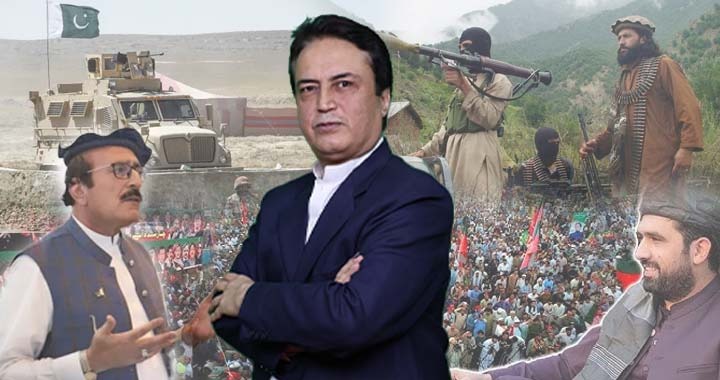
The situation in Khyber Pakhtunkhwa continues to deteriorate, and Tirah has once again turned into a hub of narco-terrorism. The question that naturally arises is whether the provincial government intends to take any serious action. The recent attack near the White House, after which Donald Trump declared Afghanistan as hell, adds to the uncertainty about what direction Washington will take in the coming days. Alongside this, the drone attack reportedly originating from Afghanistan, which killed three Chinese citizens along the Tajikistan border, has further intensified regional tensions.
As these developments unfold, it becomes necessary to examine the militant landscape within KP. Historically, Khyber Agency, now district Khyber, has long hosted Islamist militants. Tirah has remained a stronghold of four major groups, the Taliban, Mangal Bagh’s Lashkar-e-Islam, Ansar ul Islam, and Haji Namdar’s ‘Amar Bil Maroof wa Nahee Anel Munkar’. Its mountainous terrain, bordering Afghanistan and Orakzai, provides natural cover and cross-border mobility.
Despite this history, no counter militancy policy is visible today. There is no clarity from Chief Minister Sohail Afridi or his cabinet on how they intend to deal with this challenge. Neither the provincial leadership nor their party appears to grasp the gravity of the situation. The government has shown zero governance and no writ, while public issues remain unaddressed. Their single-point focus revolves around demands to meet Imran Khan and efforts to secure his release. The political theatrics, including frequent sit ins outside Adiala Jail and choreographed demonstrations, have diverted public attention from the escalating threat. The recent 16 hour sit in led by CM Afridi and PTI parliamentarians, later joined by Mehmood Khan Achakzai, only reinforced the impression that the government is preoccupied with optics instead of security. The more pertinent question that emerges is who exactly is preventing CM Afridi from meeting Imran Khan and why. The suspicion is that both sides benefit from this distraction while militancy grows unchecked.
The irony is that a man who once fought against the Taliban in Afghanistan alongside the United States travelled to America and carried out an attack on US soil. This paradox must be fully investigated. Were his motives linked to perceived atrocities committed by the United States in Afghanistan, or were there other factors at play. Only the progress of the case will reveal the truth.
Meanwhile, the drone attack in Tajikistan, which killed three Chinese nationals working on a project near the Afghan border, has raised fresh alarms. Afghanistan has already accused Pakistan of conducting a nighttime strike in Khost and Paktika that killed several civilians, an allegation Pakistan has denied. Pakistan’s position, articulated clearly by DG ISPR, is that the state does not engage in covert strikes and does not deny any operation it conducts. Now, similar accusations are being levelled in reverse. Tajikistan has accused Afghanistan of the drone strike that killed the Chinese workers, while Kabul has condemned the attack and termed it the work of elements seeking instability in the region. A high level Afghan delegation has travelled to Dushanbe to discuss the matter.
This evolving pattern, Afghanistan blaming Pakistan for an attack it denies, and Tajikistan blaming Afghanistan for an attack Kabul denies, raises critical questions. Unknown actors could be operating drones across regional borders, striking at will. There is precedent for this confusion. In Bajaur, PTI MPA Anwarzeb Khan once claimed that his guest house had been hit by a drone. The region now appears riddled with forces capable of destabilising multiple countries simultaneously.
Whether these strikes are being carried out by splinter groups within Afghanistan, or whether individuals wanted in Afghanistan are being targeted in neighbouring states, remains to be determined. Investigations will need to establish whether such groups operate autonomously across borders or whether state rivals are framing one another.
The broader concern persists. The TTP and allied organisations have become a serious threat to the entire region. While dozens of splinter outfits exist, neither Tajikistan nor Afghanistan has blamed any group other than each other’s governments for the recent incidents. The presence of various international jihadi groups on Afghan soil has created a complex security environment. Pakistan continues to suffer cross-border attacks carried out by the TTP, a phenomenon that is not new. Since Pakistan joined the US war in Afghanistan, attacks have persisted and intensified. The number of militants has grown exponentially. Where once one or two thousand fighters existed, today they reportedly number between fourteen and fifteen thousand.
Pakistan’s past decisions, particularly its deep alignment with US policy, led to a strategic trap. Senior officials within Pakistan’s security establishment have acknowledged that Pakistan was drawn into a long term American design that ensured the country remained entangled in conflict for decades. The consequences of that decision remain evident. Peace continues to recede and militancy continues to rise.
No effective counterterrorism policy can succeed until Pakistan puts its house in order. Political instability, bad governance and corruption have compounded insecurity. Pakistan’s political parties, state institutions and the public remain divided. Until there is unity on a national strategy, the country will remain vulnerable to internal and external threats. A unified national front is essential, but unity will not come unless internal corrective measures are taken.